Powered by AI
  • Home
  • Handbook
    • SQL hangbook
    • R handbook
    • Python handbook
    • Machine learning handbook
    • tensorflowing handbook
    • AI handbook
  • Blog
  • CV / 简历
  • EN/中文
    • English
    • 中文

On this page

  • Project Overview
    • Core Architecture
      • Multi-Agent AI System
      • Technology Stack
    • Database Architecture
      • Data Schema and Sources
      • Data Collection Pipeline
    • AI/ML Implementation
      • Vector Embedding Technology
      • RAG System Architecture
      • RAG Workflow
      • Similarity Search Implementation
    • Specialized Agent Implementation
      • DrunkTony (Chinese Agent)
      • WhiskyFunny (English Agent)
    • Recommendation Engine
      • Dual-LLM Recommendation System
    • User Interface Design
      • Streamlit Implementation
    • Rate Limiting and Cost Management
      • API Usage Control
    • Performance Optimization
      • Vector Database Performance
    • Deployment and Configuration
      • Environment Setup
      • Shiny for Python Alternative
    • Technical Achievements
      • Key Innovations
      • Performance Metrics
    • Future Enhancements
    • Conclusion

Whisky Tasting note with RAG

  • Show All Code
  • Hide All Code

  • View Source
AI
API
tutorial
Author

Tony D

Published

November 5, 2025

Project Overview

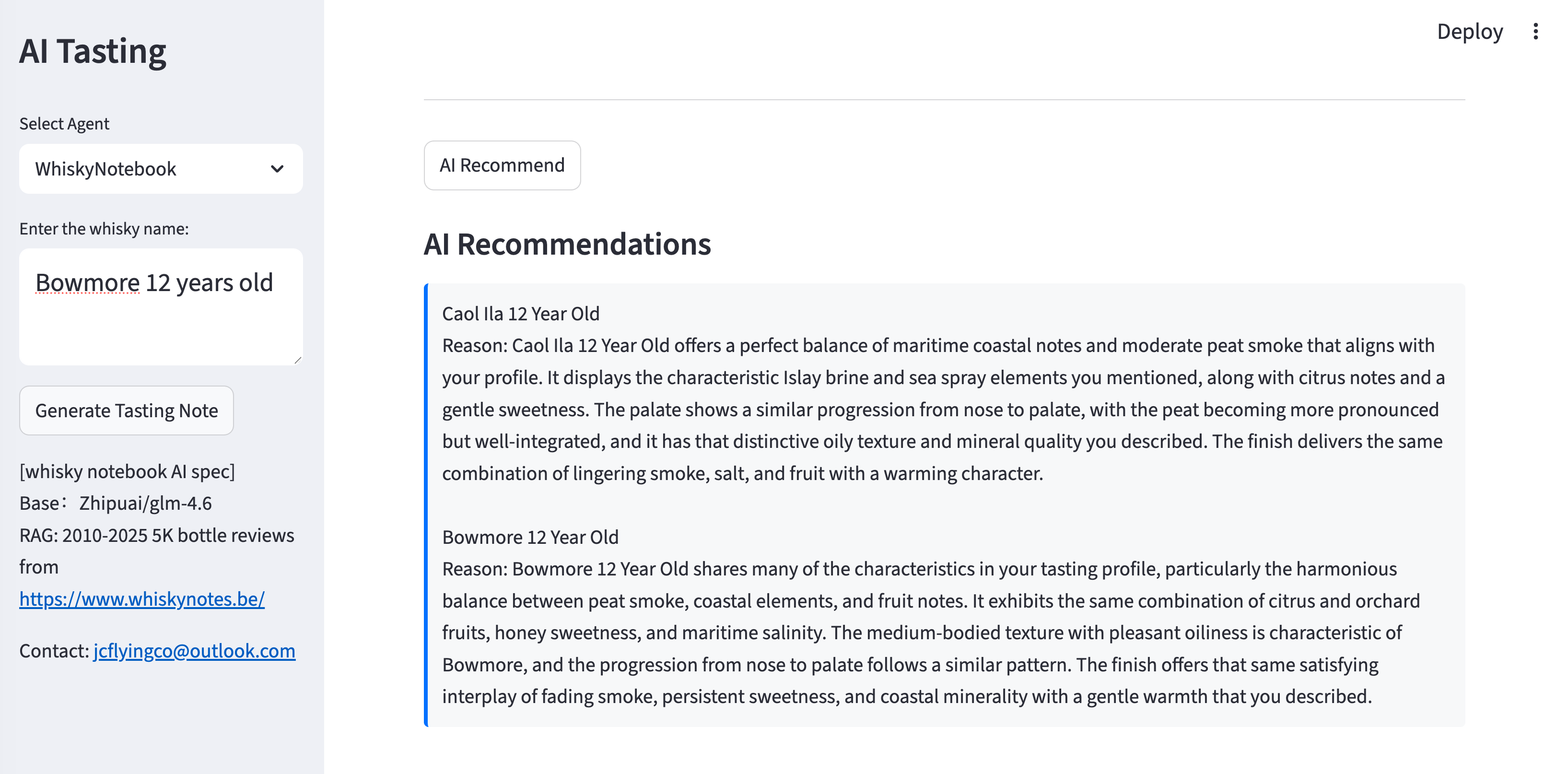
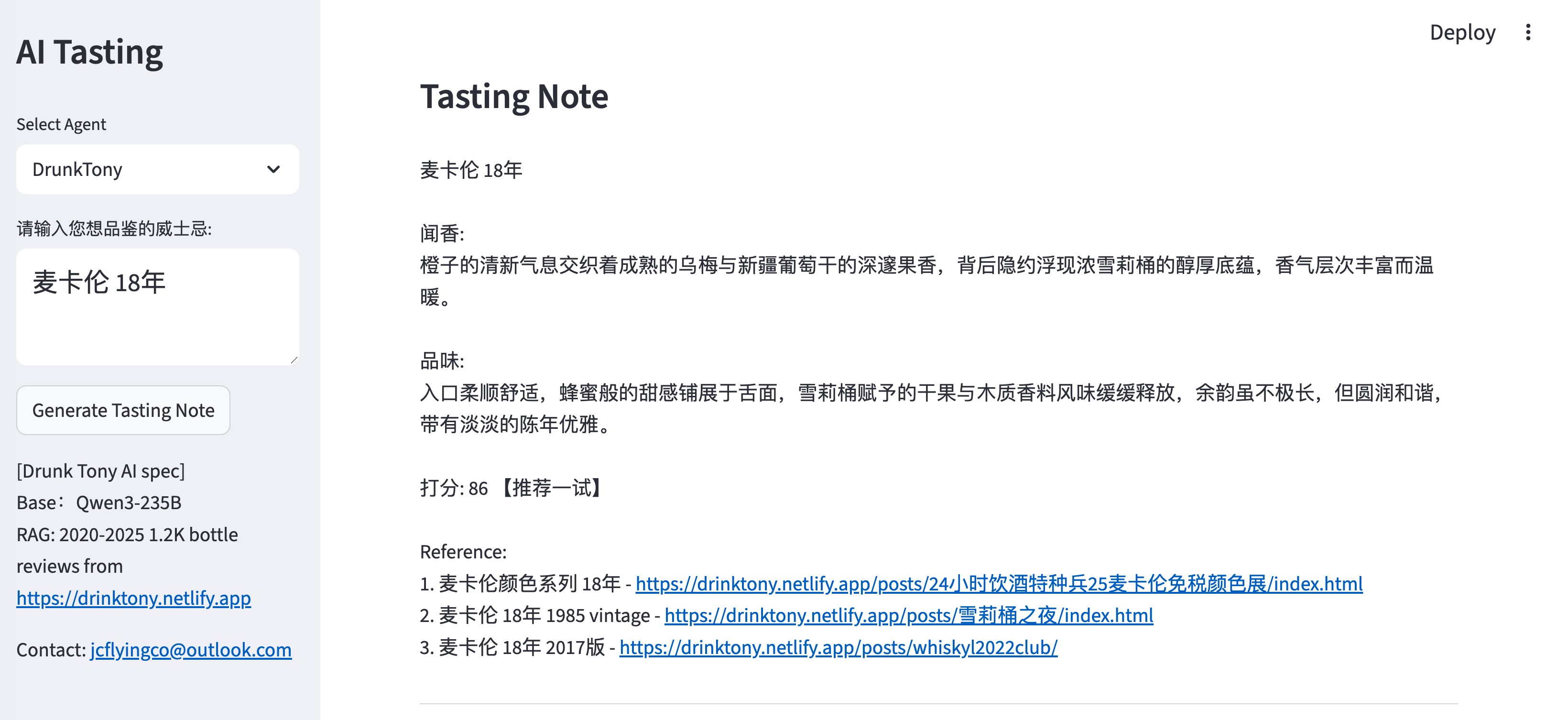
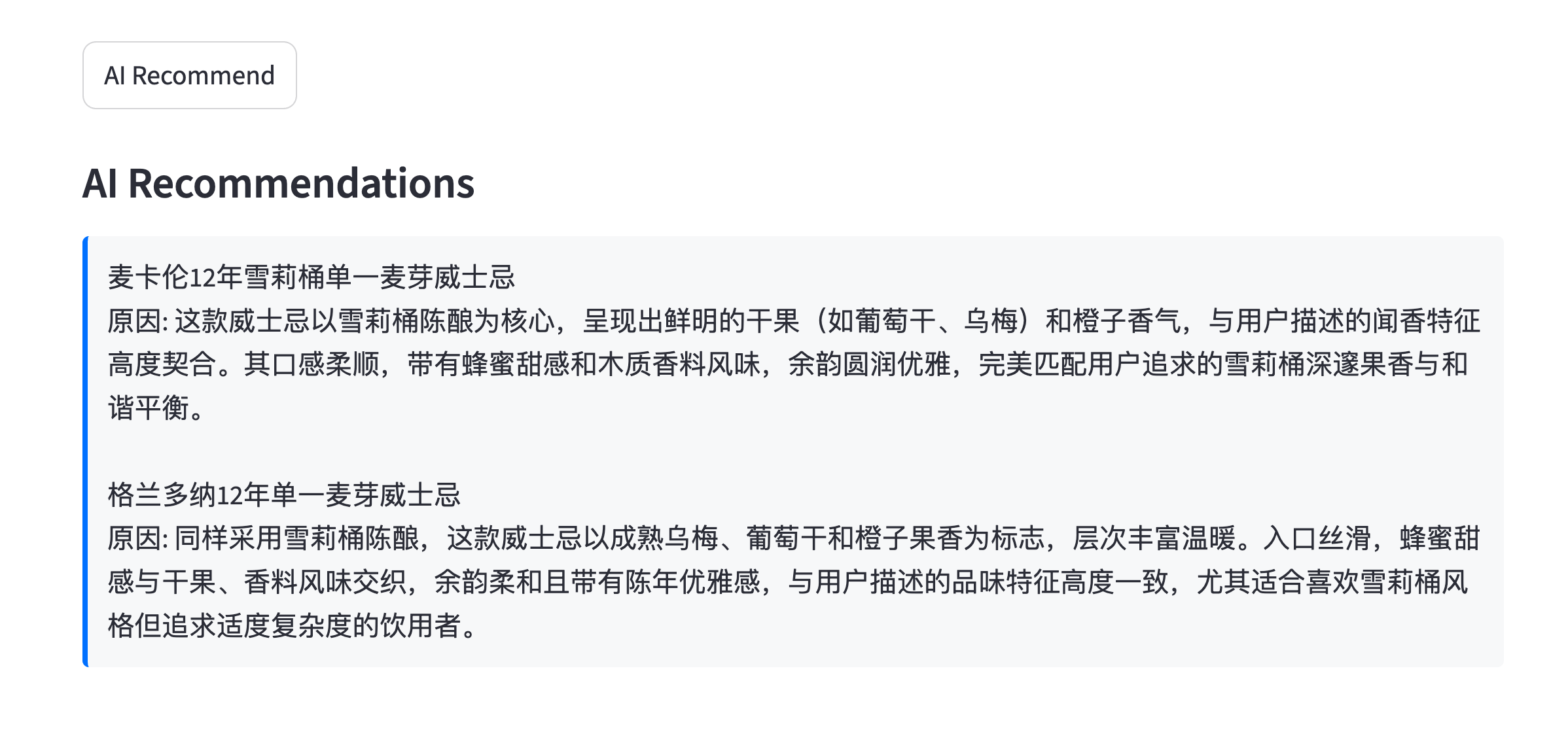
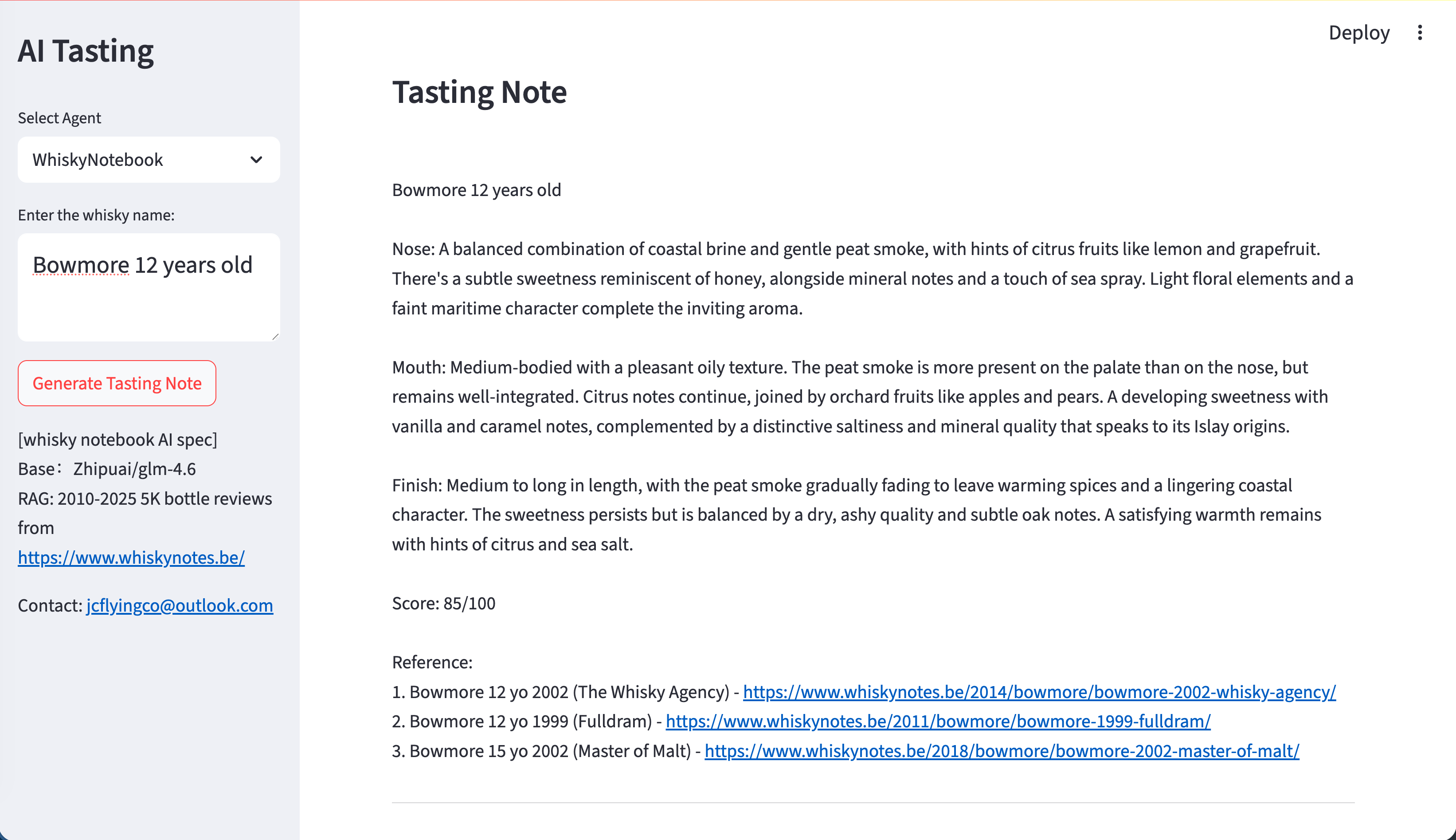
The whisky tasting application is an advanced AI-powered web application that generates detailed, professional whisky tasting notes and recommendations. What makes this system special is its multi-agent architecture with specialized AI personalities, each trained on different whisky review sources and linguistic styles.

Live Demo(modelscope): https://modelscope.cn/studios/ttflying/whisky_AI_tasting

Live Demo(shinyapp): https://jcflyingco.shinyapps.io/ai-whisky-tasting/

Github: https://github.com/JCwinning/whisky_tasting

  • AI tasting note
  • AI recommendation
  • AI品鉴词
  • AI推荐

Core Architecture

Multi-Agent AI System

The application features three specialized AI agents, each with unique characteristics and data sources:

  1. DrunkTony (dt) - Chinese-language agent specializing in Chinese whisky reviews
  2. WhiskyFunny (wf) - English-language agent with data from whiskyfun.com
  3. WhiskyNotebook (wn) - English-language agent with data from whiskynotes.be

Technology Stack

  • Primary Language: Python 3.13+
  • Web Framework: Streamlit (primary) + Shiny for Python (alternative)
  • Database: DuckDB (376MB, optimized for vector operations)
  • AI/ML: OpenAI API, Vector embeddings, RAG system
  • Data Sources: Web scraping with BeautifulSoup4

Database Architecture

Data Schema and Sources

The system uses DuckDB as its primary database, chosen for its excellent performance with vector operations:

-- Database structure
CREATE TABLE drinktony_embed (
    full TEXT,
    bottle_embedding FLOAT[1024]  -- 1024-dimensional vectors
);

CREATE TABLE whiskyfun_embed (
    full TEXT,
    bottle_embedding FLOAT[1024]
);

CREATE TABLE whiskynote_embed (
    full TEXT,
    bottle_embedding FLOAT[1024]
);

Data Collection Pipeline

Code
# Web scraping example from get_data_dt.py
def scrape_drinktony_reviews():
    """Scrape Chinese whisky reviews from drinktony.netlify.app"""
    url = "https://drinktony.netlify.app/"
    response = requests.get(url)
    soup = BeautifulSoup(response.content, "html.parser")

    # Find all review links
    post_links = [urljoin(url, a.get("href"))
                 for a in soup.select("a.quarto-grid-link")]

    all_reviews = []
    for post_url in post_links:
        response = requests.get(post_url)
        soup = BeautifulSoup(response.content, "html.parser")

        # Extract review sections
        review_sections = soup.select("section.level1")
        for section in review_sections:
            # Parse whisky name and review content
            whisky_name = extract_whisky_name(section)
            review_text = extract_review_text(section)
            all_reviews.append({
                'whisky': whisky_name,
                'review': review_text
            })

    return all_reviews

AI/ML Implementation

Vector Embedding Technology

The application uses state-of-the-art embedding technology to convert text into high-dimensional vectors for semantic similarity search.

Embedding Model Details

Model: BAAI/bge-large-zh-v1.5 - Dimensions: 1024 - Provider: SiliconFlow API - Purpose: Cross-lingual text understanding (works well for both Chinese and English)

Why BGE-Large-ZH?

  1. Cross-lingual Capability: Excels at understanding both Chinese and English whisky terminology
  2. High Performance: Superior semantic understanding compared to generic embeddings
  3. Efficient Size: 1024 dimensions balance between performance and storage efficiency
  4. API Access: Stable service via SiliconFlow

Embedding Process

The application uses BGE-Large-ZH-v1.5 model for generating embeddings:

Code
def get_embedding(text: str, api_key: str):
    """Generate text embeddings using SiliconFlow API"""
    client = OpenAI(
        api_key=api_key,
        base_url="https://api.siliconflow.cn/v1"
    )
    response = client.embeddings.create(
        model="BAAI/bge-large-zh-v1.5",
        input=[text]
    )
    return np.array(response.data[0].embedding)

def cosine_similarity(v1, v2):
    """Calculate cosine similarity between two vectors"""
    if v1 is None or v2 is None:
        return 0
    return np.dot(v1, v2) / (np.linalg.norm(v1) * np.linalg.norm(v2))

RAG System Architecture

The Retrieval-Augmented Generation (RAG) system is the core innovation of this application. Let’s explore its components in detail.

RAG Workflow

The Retrieval-Augmented Generation process follows these steps:

%%| fig-cap: "RAG Workflow for Whisky Tasting"
flowchart TD
    A[User Input<br/>Whisky Name] --> B[Generate Embedding]
    B --> C[Vector Similarity Search<br/>in DuckDB]
    C --> D[Retrieve Top 10<br/>Similar Reviews]
    D --> E[Format Context for LLM]
    E --> F[Generate Tasting Notes<br/>with Primary LLM]
    F --> G[Generate Recommendations<br/>with Secondary LLM]
    G --> H[Display Results<br/>with Formatting]

    C --> I[Databases]
    I --> J[drinktony_embed<br/>1.2K Chinese reviews]
    I --> K[whiskyfun_embed<br/>20K English reviews]
    I --> L[whiskynote_embed<br/>5K English reviews]

Similarity Search Implementation

Code
def find_similar_chunks(
    query_embedding,
    db_path,
    table_name,
    text_col,
    embedding_col,
    top_n=10,
):
    """Find most similar chunks in database using cosine similarity"""
    try:
        with duckdb.connect(database=db_path, read_only=True) as con:
            df = con.execute(
                f'SELECT "{text_col}", "{embedding_col}" FROM "{table_name}"'
            ).fetchdf()

            # Calculate similarities
            similarities = []
            for _, row in df.iterrows():
                text = row[text_col]
                embedding = np.array(row[embedding_col])
                similarity = cosine_similarity(query_embedding, embedding)
                similarities.append((text, similarity))

            # Sort by similarity and return top N
            similarities.sort(key=lambda x: x[1], reverse=True)
            return similarities[:top_n]

    except Exception as e:
        print(f"Error searching similar chunks: {e}")
        return []

Specialized Agent Implementation

DrunkTony (Chinese Agent)

Code
def run_conversation(query, api_key, model):
    """Generate whisky tasting notes in Chinese format"""

    # Step 1: Generate embedding and find similar reviews
    query_embedding = get_embedding(query, api_key)
    similar_reviews = find_similar_chunks(
        query_embedding=query_embedding,
        db_path="data/whisky_database.duckdb",
        table_name="drinktony_embed",
        text_col="full",
        embedding_col="bottle_embedding"
    )

    # Step 2: Format context for LLM
    context = "\n---\n".join([review[0] for review in similar_reviews])

    # Step 3: Generate tasting notes
    prompt = f"""作为威士忌专家,基于以下威士忌品鉴笔记,为"{query}"生成专业的品鉴报告:

参考品鉴笔记:
{context}

请按以下格式输出:
{query}
闻香: [详细描述]
品味: [详细描述]
打分: [90-100分]
"""

    response = llm_client.chat.completions.create(
        model=model,
        messages=[
            {"role": "system", "content": "你是一位专业的威士忌品鉴师,擅长生成详细准确的品鉴笔记。"},
            {"role": "user", "content": prompt}
        ],
        temperature=0.7,
        max_tokens=1000
    )

    return response.choices[0].message.content

WhiskyFunny (English Agent)

Code
def run_conversation(query, api_key, model):
    """Generate whisky tasting notes in English format"""

    query_embedding = get_embedding(query, api_key)
    similar_reviews = find_similar_chunks(
        query_embedding=query_embedding,
        db_path="data/whisky_database.duckdb",
        table_name="whiskyfun_embed",
        text_col="full",
        embedding_col="bottle_embedding"
    )

    context = "\n---\n".join([review[0] for review in similar_reviews])

    prompt = f"""As a whisky expert, generate professional tasting notes for "{query}" based on these reference reviews:

Reference reviews:
{context}

Please output in this format:
Colour: [detailed description]
Nose: [detailed aroma description]
Mouth: [detailed taste description]
Finish: [detailed finish description]
Comments: [overall impression]
SGP: xxx - xx points
"""

    response = llm_client.chat.completions.create(
        model=model,
        messages=[
            {"role": "system", "content": "You are a professional whisky taster specializing in detailed sensory analysis."},
            {"role": "user", "content": prompt}
        ],
        temperature=0.7,
        max_tokens=1200
    )

    return response.choices[0].message.content

Recommendation Engine

Dual-LLM Recommendation System

The application uses a separate LLM for generating whisky recommendations:

Code
def recommend_whiskies_by_profile(tasting_notes, api_key, model):
    """Generate whisky recommendations based on tasting profile"""

    prompt = f"""Based on these tasting notes, recommend 2 similar whiskies that the user might enjoy:

{Tasting Notes:}
{tasting_notes}

Please provide:
1. Whisky name with brief description
2. Why it matches the user's preference
3. Price range and availability

Format each recommendation as:
**Recommendation [1/2]:** [Whisky Name]
**Why it matches:** [detailed reasoning]
**Details:** [price, availability, tasting profile]
"""

    response = recommendation_client.chat.completions.create(
        model=model,  # Different model for recommendations
        messages=[
            {"role": "system", "content": "You are a whisky recommendation expert with deep knowledge of global whisky brands and profiles."},
            {"role": "user", "content": prompt}
        ],
        temperature=0.8,
        max_tokens=800
    )

    return response.choices[0].message.content

User Interface Design

Streamlit Implementation

Code
# Main application interface
def main():
    st.set_page_config(
        page_title="AI Whisky Tasting System",
        page_icon="🥃",
        layout="wide"
    )

    # Sidebar for agent selection
    with st.sidebar:
        st.header("🥃 Whisky AI Tasting")

        # Agent selection
        agent_type = st.selectbox(
            "Select Tasting Agent:",
            ["DrunkTony (中文)", "WhiskyFunny (English)", "WhiskyNotebook (English)"],
            help="Each agent has different personality and data sources"
        )

        # Model selection
        model_options = get_model_options(agent_type)
        selected_model = st.selectbox("Model:", model_options)

    # Main content area
    st.header("Professional Whisky Tasting Notes Generator")

    # Input section
    col1, col2 = st.columns([2, 1])
    with col1:
        whisky_name = st.text_input(
            "Enter whisky name:",
            placeholder="e.g., Macallan 18 Year Old",
            help="Enter the full whisky name including age and cask type"
        )

    with col2:
        st.write("")  # Spacer
        generate_btn = st.button("🍷 Generate Tasting Notes", type="primary")
        recommend_btn = st.button("🎯 Get Recommendations")

    # Output sections
    if generate_btn:
        if not whisky_name:
            st.error("Please enter a whisky name")
        else:
            with st.spinner("Analyzing whisky..."):
                tasting_notes = generate_tasting_notes(whisky_name, agent_type, selected_model)
                st.markdown("### 🥃 Tasting Notes")
                st.markdown(tasting_notes)

    if recommend_btn:
        with st.spinner("Finding recommendations..."):
            recommendations = get_recommendations(tasting_notes, agent_type)
            st.markdown("### 🎯 Personalized Recommendations")
            st.markdown(recommendations)

Rate Limiting and Cost Management

API Usage Control

Code
# Rate limiting implementation
RATE_LIMIT_FILE = "rate_limit.json"
MAX_RUNS_PER_DAY = 80

def get_rate_limit_data():
    """Get current usage data"""
    try:
        with open(RATE_LIMIT_FILE, "r") as f:
            data = json.load(f)
            # Ensure keys exist
            if "date" not in data or "count" not in data:
                return {"date": str(datetime.date.today()), "count": 0}
            return data
    except (FileNotFoundError, json.JSONDecodeError):
        return {"date": str(datetime.date.today()), "count": 0}

def check_rate_limit():
    """Check if user has exceeded daily limit"""
    data = get_rate_limit_data()
    today = str(datetime.date.today())

    if data["date"] != today:
        # Reset counter for new day
        return {"date": today, "count": 0, "can_run": True}

    if data["count"] >= MAX_RUNS_PER_DAY:
        return {"date": today, "count": data["count"], "can_run": False}

    return {"date": today, "count": data["count"], "can_run": True}

Performance Optimization

Vector Database Performance

Code
# Optimized similarity search with batching
def batch_similarity_search(query_embedding, db_path, table_name, batch_size=1000):
    """Optimized similarity search with batching for large datasets"""

    with duckdb.connect(database=db_path, read_only=True) as con:
        # Get total row count
        total_rows = con.execute(f"SELECT COUNT(*) FROM {table_name}").fetchone()[0]

        all_similarities = []

        # Process in batches to manage memory
        for offset in range(0, total_rows, batch_size):
            batch_df = con.execute(
                f'SELECT full, bottle_embedding FROM {table_name} LIMIT {batch_size} OFFSET {offset}'
            ).fetchdf()

            # Calculate similarities for batch
            for _, row in batch_df.iterrows():
                embedding = np.array(row['bottle_embedding'])
                similarity = cosine_similarity(query_embedding, embedding)
                all_similarities.append((row['full'], similarity))

        # Sort and return top results
        all_similarities.sort(key=lambda x: x[1], reverse=True)
        return all_similarities[:10]

Deployment and Configuration

Environment Setup

# Environment variables in .env file
SILICONFLOW_API_KEY=your_siliconflow_key
MODELSCOPE_API_KEY=your_modelscope_key
GEMINI_API_KEY=your_gemini_key  # Optional

# Database initialization
python -c "
import duckdb
conn = duckdb.connect('data/whisky_database.duckdb')
# Create tables with vector support
"

Shiny for Python Alternative

Code
# Alternative UI implementation using Shiny
from shiny import App, ui, render, reactive, req

app_ui = ui.page_fluid(
    ui.h2("🥃 AI Whisky Tasting System"),
    ui.layout_sidebar(
        ui.sidebar(
            ui.input_select("agent", "Select Agent:", [
                "DrunkTony (中文)", "WhiskyFunny (English)", "WhiskyNotebook (English)"
            ]),
            ui.input_text("whisky_name", "Whisky Name:", ""),
            ui.input_action_button("generate", "Generate Notes")
        ),
        ui.output_text_verbatim("tasting_notes"),
        ui.output_text_verbatim("recommendations")
    )
)

def server(input, output, session):
    @output
    @render.text
    def tasting_notes():
        req(input.generate())
        # Generate tasting notes logic
        return generate_tasting_notes(input.whisky_name(), input.agent())

app = App(app_ui, server)

Technical Achievements

Key Innovations

  1. Multi-Agent Architecture: Different AI personalities and data sources
  2. RAG Implementation: Retrieval-augmented generation with real whisky reviews
  3. Vector Database: Efficient similarity search with 376MB database
  4. Bilingual Support: Chinese and English language agents
  5. Cost Management: Built-in rate limiting and API optimization
  6. Professional Tasting Formats: Industry-standard note structures

Performance Metrics

Metric Value
Database Size 376MB (26K+ reviews)
Embedding Dimension 1024
Search Latency <2 seconds
Daily Request Limit 80 requests
Support Languages 2 (EN/ZH)
Data Sources 3 (drinktony, whiskyfun, whiskynotes)

Future Enhancements

Potential improvements for next versions:

  1. Advanced Similarity Algorithms: Implement hybrid search with text + metadata
  2. User Personalization: Learn from user preferences over time
  3. Mobile App: Native iOS/Android applications
  4. Real-time Data Updates: Automated web scraping pipeline
  5. Tasting Profile Analysis: Generate user taste profiles from preferences
  6. Social Features: Share tasting notes and recommendations with community

Conclusion

This whisky tasting application demonstrates the power of combining RAG technology with specialized AI agents to create a sophisticated domain-specific system. The project showcases:

  • Advanced AI Architecture: Multi-agent system with different personalities
  • Data Engineering: Large-scale vector database management
  • Professional Knowledge: Industry-standard tasting note formats
  • User Experience: Clean, intuitive interfaces across platforms
  • Cost Efficiency: Smart rate limiting and optimization

Whether you’re a whisky enthusiast, AI developer, or data scientist, this project provides an excellent example of building production-grade AI applications that combine real-world data with advanced machine learning techniques.


Technology Stack: Python, Streamlit, DuckDB, OpenAI API, Vector Embeddings

Database: 26K+ real whisky reviews across 3 specialized sources

Source Code
---
title: "Whisky Tasting note with RAG"
author: "Tony D"
date: "2025-11-05"
categories: [AI, API, tutorial]
image: "images/0.png"

format:
  html:
    code-fold: true
    code-tools: true
    code-copy: true

execute:
  eval: false
  warning: false


---


# Project Overview

The whisky tasting application is an advanced AI-powered web application that generates detailed, professional whisky tasting notes and recommendations. What makes this system special is its multi-agent architecture with specialized AI personalities, each trained on different whisky review sources and linguistic styles.

Live Demo(modelscope): [https://modelscope.cn/studios/ttflying/whisky_AI_tasting](https://modelscope.cn/studios/ttflying/whisky_AI_tasting)

Live Demo(shinyapp): [https://jcflyingco.shinyapps.io/ai-whisky-tasting/](https://jcflyingco.shinyapps.io/ai-whisky-tasting)

Github: [https://github.com/JCwinning/whisky_tasting](https://github.com/JCwinning/whisky_tasting)


::: {.panel-tabset}


## AI tasting note
![](images/2.png){width="100%"}

## AI recommendation

![](images/3.png){width="100%"}


## AI品鉴词
![](images/0.png){width="100%"}


## AI推荐

![](images/1.png){width="100%"}


::: 


## Core Architecture

### Multi-Agent AI System

The application features three specialized AI agents, each with unique characteristics and data sources:

1. **DrunkTony (dt)** - Chinese-language agent specializing in Chinese whisky reviews
2. **WhiskyFunny (wf)** - English-language agent with data from whiskyfun.com
3. **WhiskyNotebook (wn)** - English-language agent with data from whiskynotes.be

### Technology Stack
- **Primary Language**: Python 3.13+
- **Web Framework**: Streamlit (primary) + Shiny for Python (alternative)
- **Database**: DuckDB (376MB, optimized for vector operations)
- **AI/ML**: OpenAI API, Vector embeddings, RAG system
- **Data Sources**: Web scraping with BeautifulSoup4


## Database Architecture

### Data Schema and Sources

The system uses DuckDB as its primary database, chosen for its excellent performance with vector operations:

```sql
-- Database structure
CREATE TABLE drinktony_embed (
    full TEXT,
    bottle_embedding FLOAT[1024]  -- 1024-dimensional vectors
);

CREATE TABLE whiskyfun_embed (
    full TEXT,
    bottle_embedding FLOAT[1024]
);

CREATE TABLE whiskynote_embed (
    full TEXT,
    bottle_embedding FLOAT[1024]
);
```

### Data Collection Pipeline

```{python}
# Web scraping example from get_data_dt.py
def scrape_drinktony_reviews():
    """Scrape Chinese whisky reviews from drinktony.netlify.app"""
    url = "https://drinktony.netlify.app/"
    response = requests.get(url)
    soup = BeautifulSoup(response.content, "html.parser")

    # Find all review links
    post_links = [urljoin(url, a.get("href"))
                 for a in soup.select("a.quarto-grid-link")]

    all_reviews = []
    for post_url in post_links:
        response = requests.get(post_url)
        soup = BeautifulSoup(response.content, "html.parser")

        # Extract review sections
        review_sections = soup.select("section.level1")
        for section in review_sections:
            # Parse whisky name and review content
            whisky_name = extract_whisky_name(section)
            review_text = extract_review_text(section)
            all_reviews.append({
                'whisky': whisky_name,
                'review': review_text
            })

    return all_reviews
```

## AI/ML Implementation

### Vector Embedding Technology

The application uses state-of-the-art embedding technology to convert text into high-dimensional vectors for semantic similarity search.

#### Embedding Model Details

**Model**: BAAI/bge-large-zh-v1.5
- **Dimensions**: 1024
- **Provider**: SiliconFlow API
- **Purpose**: Cross-lingual text understanding (works well for both Chinese and English)

#### Why BGE-Large-ZH?

1. **Cross-lingual Capability**: Excels at understanding both Chinese and English whisky terminology
2. **High Performance**: Superior semantic understanding compared to generic embeddings
3. **Efficient Size**: 1024 dimensions balance between performance and storage efficiency
4. **API Access**: Stable service via SiliconFlow

#### Embedding Process

The application uses BGE-Large-ZH-v1.5 model for generating embeddings:

```{python}
def get_embedding(text: str, api_key: str):
    """Generate text embeddings using SiliconFlow API"""
    client = OpenAI(
        api_key=api_key,
        base_url="https://api.siliconflow.cn/v1"
    )
    response = client.embeddings.create(
        model="BAAI/bge-large-zh-v1.5",
        input=[text]
    )
    return np.array(response.data[0].embedding)

def cosine_similarity(v1, v2):
    """Calculate cosine similarity between two vectors"""
    if v1 is None or v2 is None:
        return 0
    return np.dot(v1, v2) / (np.linalg.norm(v1) * np.linalg.norm(v2))
```

### RAG System Architecture

The Retrieval-Augmented Generation (RAG) system is the core innovation of this application. Let's explore its components in detail.

### RAG Workflow

The Retrieval-Augmented Generation process follows these steps:

```mermaid
%%| fig-cap: "RAG Workflow for Whisky Tasting"
flowchart TD
    A[User Input<br/>Whisky Name] --> B[Generate Embedding]
    B --> C[Vector Similarity Search<br/>in DuckDB]
    C --> D[Retrieve Top 10<br/>Similar Reviews]
    D --> E[Format Context for LLM]
    E --> F[Generate Tasting Notes<br/>with Primary LLM]
    F --> G[Generate Recommendations<br/>with Secondary LLM]
    G --> H[Display Results<br/>with Formatting]

    C --> I[Databases]
    I --> J[drinktony_embed<br/>1.2K Chinese reviews]
    I --> K[whiskyfun_embed<br/>20K English reviews]
    I --> L[whiskynote_embed<br/>5K English reviews]
```

### Similarity Search Implementation

```{python}
def find_similar_chunks(
    query_embedding,
    db_path,
    table_name,
    text_col,
    embedding_col,
    top_n=10,
):
    """Find most similar chunks in database using cosine similarity"""
    try:
        with duckdb.connect(database=db_path, read_only=True) as con:
            df = con.execute(
                f'SELECT "{text_col}", "{embedding_col}" FROM "{table_name}"'
            ).fetchdf()

            # Calculate similarities
            similarities = []
            for _, row in df.iterrows():
                text = row[text_col]
                embedding = np.array(row[embedding_col])
                similarity = cosine_similarity(query_embedding, embedding)
                similarities.append((text, similarity))

            # Sort by similarity and return top N
            similarities.sort(key=lambda x: x[1], reverse=True)
            return similarities[:top_n]

    except Exception as e:
        print(f"Error searching similar chunks: {e}")
        return []
```

## Specialized Agent Implementation

### DrunkTony (Chinese Agent)

```{python}
def run_conversation(query, api_key, model):
    """Generate whisky tasting notes in Chinese format"""

    # Step 1: Generate embedding and find similar reviews
    query_embedding = get_embedding(query, api_key)
    similar_reviews = find_similar_chunks(
        query_embedding=query_embedding,
        db_path="data/whisky_database.duckdb",
        table_name="drinktony_embed",
        text_col="full",
        embedding_col="bottle_embedding"
    )

    # Step 2: Format context for LLM
    context = "\n---\n".join([review[0] for review in similar_reviews])

    # Step 3: Generate tasting notes
    prompt = f"""作为威士忌专家,基于以下威士忌品鉴笔记,为"{query}"生成专业的品鉴报告:

参考品鉴笔记:
{context}

请按以下格式输出:
{query}
闻香: [详细描述]
品味: [详细描述]
打分: [90-100分]
"""

    response = llm_client.chat.completions.create(
        model=model,
        messages=[
            {"role": "system", "content": "你是一位专业的威士忌品鉴师,擅长生成详细准确的品鉴笔记。"},
            {"role": "user", "content": prompt}
        ],
        temperature=0.7,
        max_tokens=1000
    )

    return response.choices[0].message.content
```

### WhiskyFunny (English Agent)

```{python}
def run_conversation(query, api_key, model):
    """Generate whisky tasting notes in English format"""

    query_embedding = get_embedding(query, api_key)
    similar_reviews = find_similar_chunks(
        query_embedding=query_embedding,
        db_path="data/whisky_database.duckdb",
        table_name="whiskyfun_embed",
        text_col="full",
        embedding_col="bottle_embedding"
    )

    context = "\n---\n".join([review[0] for review in similar_reviews])

    prompt = f"""As a whisky expert, generate professional tasting notes for "{query}" based on these reference reviews:

Reference reviews:
{context}

Please output in this format:
Colour: [detailed description]
Nose: [detailed aroma description]
Mouth: [detailed taste description]
Finish: [detailed finish description]
Comments: [overall impression]
SGP: xxx - xx points
"""

    response = llm_client.chat.completions.create(
        model=model,
        messages=[
            {"role": "system", "content": "You are a professional whisky taster specializing in detailed sensory analysis."},
            {"role": "user", "content": prompt}
        ],
        temperature=0.7,
        max_tokens=1200
    )

    return response.choices[0].message.content
```

## Recommendation Engine

### Dual-LLM Recommendation System

The application uses a separate LLM for generating whisky recommendations:

```{python}
def recommend_whiskies_by_profile(tasting_notes, api_key, model):
    """Generate whisky recommendations based on tasting profile"""

    prompt = f"""Based on these tasting notes, recommend 2 similar whiskies that the user might enjoy:

{Tasting Notes:}
{tasting_notes}

Please provide:
1. Whisky name with brief description
2. Why it matches the user's preference
3. Price range and availability

Format each recommendation as:
**Recommendation [1/2]:** [Whisky Name]
**Why it matches:** [detailed reasoning]
**Details:** [price, availability, tasting profile]
"""

    response = recommendation_client.chat.completions.create(
        model=model,  # Different model for recommendations
        messages=[
            {"role": "system", "content": "You are a whisky recommendation expert with deep knowledge of global whisky brands and profiles."},
            {"role": "user", "content": prompt}
        ],
        temperature=0.8,
        max_tokens=800
    )

    return response.choices[0].message.content
```

## User Interface Design

### Streamlit Implementation

```{python}
# Main application interface
def main():
    st.set_page_config(
        page_title="AI Whisky Tasting System",
        page_icon="🥃",
        layout="wide"
    )

    # Sidebar for agent selection
    with st.sidebar:
        st.header("🥃 Whisky AI Tasting")

        # Agent selection
        agent_type = st.selectbox(
            "Select Tasting Agent:",
            ["DrunkTony (中文)", "WhiskyFunny (English)", "WhiskyNotebook (English)"],
            help="Each agent has different personality and data sources"
        )

        # Model selection
        model_options = get_model_options(agent_type)
        selected_model = st.selectbox("Model:", model_options)

    # Main content area
    st.header("Professional Whisky Tasting Notes Generator")

    # Input section
    col1, col2 = st.columns([2, 1])
    with col1:
        whisky_name = st.text_input(
            "Enter whisky name:",
            placeholder="e.g., Macallan 18 Year Old",
            help="Enter the full whisky name including age and cask type"
        )

    with col2:
        st.write("")  # Spacer
        generate_btn = st.button("🍷 Generate Tasting Notes", type="primary")
        recommend_btn = st.button("🎯 Get Recommendations")

    # Output sections
    if generate_btn:
        if not whisky_name:
            st.error("Please enter a whisky name")
        else:
            with st.spinner("Analyzing whisky..."):
                tasting_notes = generate_tasting_notes(whisky_name, agent_type, selected_model)
                st.markdown("### 🥃 Tasting Notes")
                st.markdown(tasting_notes)

    if recommend_btn:
        with st.spinner("Finding recommendations..."):
            recommendations = get_recommendations(tasting_notes, agent_type)
            st.markdown("### 🎯 Personalized Recommendations")
            st.markdown(recommendations)
```


## Rate Limiting and Cost Management

### API Usage Control

```{python}
# Rate limiting implementation
RATE_LIMIT_FILE = "rate_limit.json"
MAX_RUNS_PER_DAY = 80

def get_rate_limit_data():
    """Get current usage data"""
    try:
        with open(RATE_LIMIT_FILE, "r") as f:
            data = json.load(f)
            # Ensure keys exist
            if "date" not in data or "count" not in data:
                return {"date": str(datetime.date.today()), "count": 0}
            return data
    except (FileNotFoundError, json.JSONDecodeError):
        return {"date": str(datetime.date.today()), "count": 0}

def check_rate_limit():
    """Check if user has exceeded daily limit"""
    data = get_rate_limit_data()
    today = str(datetime.date.today())

    if data["date"] != today:
        # Reset counter for new day
        return {"date": today, "count": 0, "can_run": True}

    if data["count"] >= MAX_RUNS_PER_DAY:
        return {"date": today, "count": data["count"], "can_run": False}

    return {"date": today, "count": data["count"], "can_run": True}
```

## Performance Optimization

### Vector Database Performance

```{python}
# Optimized similarity search with batching
def batch_similarity_search(query_embedding, db_path, table_name, batch_size=1000):
    """Optimized similarity search with batching for large datasets"""

    with duckdb.connect(database=db_path, read_only=True) as con:
        # Get total row count
        total_rows = con.execute(f"SELECT COUNT(*) FROM {table_name}").fetchone()[0]

        all_similarities = []

        # Process in batches to manage memory
        for offset in range(0, total_rows, batch_size):
            batch_df = con.execute(
                f'SELECT full, bottle_embedding FROM {table_name} LIMIT {batch_size} OFFSET {offset}'
            ).fetchdf()

            # Calculate similarities for batch
            for _, row in batch_df.iterrows():
                embedding = np.array(row['bottle_embedding'])
                similarity = cosine_similarity(query_embedding, embedding)
                all_similarities.append((row['full'], similarity))

        # Sort and return top results
        all_similarities.sort(key=lambda x: x[1], reverse=True)
        return all_similarities[:10]
```

## Deployment and Configuration

### Environment Setup

```bash
# Environment variables in .env file
SILICONFLOW_API_KEY=your_siliconflow_key
MODELSCOPE_API_KEY=your_modelscope_key
GEMINI_API_KEY=your_gemini_key  # Optional

# Database initialization
python -c "
import duckdb
conn = duckdb.connect('data/whisky_database.duckdb')
# Create tables with vector support
"
```


### Shiny for Python Alternative

```{python}
# Alternative UI implementation using Shiny
from shiny import App, ui, render, reactive, req

app_ui = ui.page_fluid(
    ui.h2("🥃 AI Whisky Tasting System"),
    ui.layout_sidebar(
        ui.sidebar(
            ui.input_select("agent", "Select Agent:", [
                "DrunkTony (中文)", "WhiskyFunny (English)", "WhiskyNotebook (English)"
            ]),
            ui.input_text("whisky_name", "Whisky Name:", ""),
            ui.input_action_button("generate", "Generate Notes")
        ),
        ui.output_text_verbatim("tasting_notes"),
        ui.output_text_verbatim("recommendations")
    )
)

def server(input, output, session):
    @output
    @render.text
    def tasting_notes():
        req(input.generate())
        # Generate tasting notes logic
        return generate_tasting_notes(input.whisky_name(), input.agent())

app = App(app_ui, server)
```


## Technical Achievements

### Key Innovations

1. **Multi-Agent Architecture**: Different AI personalities and data sources
2. **RAG Implementation**: Retrieval-augmented generation with real whisky reviews
3. **Vector Database**: Efficient similarity search with 376MB database
4. **Bilingual Support**: Chinese and English language agents
5. **Cost Management**: Built-in rate limiting and API optimization
6. **Professional Tasting Formats**: Industry-standard note structures

### Performance Metrics

| Metric | Value |
|--------|-------|
| Database Size | 376MB (26K+ reviews) |
| Embedding Dimension | 1024 |
| Search Latency | <2 seconds |
| Daily Request Limit | 80 requests |
| Support Languages | 2 (EN/ZH) |
| Data Sources | 3 (drinktony, whiskyfun, whiskynotes) |

## Future Enhancements

Potential improvements for next versions:

1. **Advanced Similarity Algorithms**: Implement hybrid search with text + metadata
2. **User Personalization**: Learn from user preferences over time
3. **Mobile App**: Native iOS/Android applications
4. **Real-time Data Updates**: Automated web scraping pipeline
5. **Tasting Profile Analysis**: Generate user taste profiles from preferences
6. **Social Features**: Share tasting notes and recommendations with community

## Conclusion

This whisky tasting application demonstrates the power of combining RAG technology with specialized AI agents to create a sophisticated domain-specific system. The project showcases:

- **Advanced AI Architecture**: Multi-agent system with different personalities
- **Data Engineering**: Large-scale vector database management
- **Professional Knowledge**: Industry-standard tasting note formats
- **User Experience**: Clean, intuitive interfaces across platforms
- **Cost Efficiency**: Smart rate limiting and optimization

Whether you're a whisky enthusiast, AI developer, or data scientist, this project provides an excellent example of building production-grade AI applications that combine real-world data with advanced machine learning techniques.

---


**Technology Stack**: Python, Streamlit, DuckDB, OpenAI API, Vector Embeddings

**Database**: 26K+ real whisky reviews across 3 specialized sources



This blog is built with ❤️ and Quarto.